Sokudo v0.20.2 is here, and it rounds up everything since v0.19.6: v0.20.0 and v0.20.1, both released on November 7, and this hotfix. Your agents work smarter and their teams are easier to follow, agent turns carry less while agents get better at using their tools, and a round of fixes makes the chat, the Database Manager and the managed engine steadier.
Smarter agents, visible teams
Workers that fit the ticket
Every swarm worker now runs with full capability, and the separate investigation role is gone. Sokudo also decides, ticket by ticket, whether a worker runs in a worktree of its own or in your shared checkout. It goes by the ticket's label on the kanban board, a hint from the lead, Jev, or the wording of the ticket itself. When a worker edits the shared checkout, Sokudo counts those edits, and the worker's card offers Run again in a worktree.
See your team at work
A lead's team is now visible: you see what each worker is doing, with a Stop team button and an attention pill. When an agent is asking you something, a line above the composer tells you.
Better questions, safer secrets
Agents ask their questions through Sokudo's ask tools, and a worker reads its ticket before it asks you anything. When an agent tests a flow in your UI end to end, it walks the flow step by step. When an agent needs a credential, it asks through a private card with a desktop notification. The secret stays on disk for 24 hours and never enters the chat.
Skills, rate limits and Muse
Type a slash anywhere in the composer to mention a skill, and mention several in one message. It works for all eight CLIs: Claude, Codex, Antigravity, OpenCode, Grok, Muse, Pi and Kiro.
When a worker hits a rate limit, it shows a Limited card with the time the limit resets. Sokudo reads that time from the provider's own reply, and that covers Codex and Gemini errors and a monthly spend cap too.
With Muse, a follow-up you send while Muse is working goes into the turn that is already running.
Nothing lost on a restart
The end of every turn is now confirmed by the window that shows the chat, and sent again when the message was lost, so a finished turn no longer looks stuck. Queued follow-ups are saved for each chat and survive a reload. If a crash cuts a turn short, the next launch shows an Interrupted row, and the agent sees it in its transcript too.
After a restart, worker cards that were still due are written once, and the restart line offers Resume, Review, Start now and, new in v0.20.2, Dismiss. It lists only work that nobody ran again and that the board does not show as done.
Agents carry less, and get better at tools
Every agent turn carries the descriptions of the tools the agent can use. That is a fixed cost, paid on every message, and a long session pays it many times over. In v0.20.0 it is 27 to 33 percent smaller in each of the eight chat types we measured.
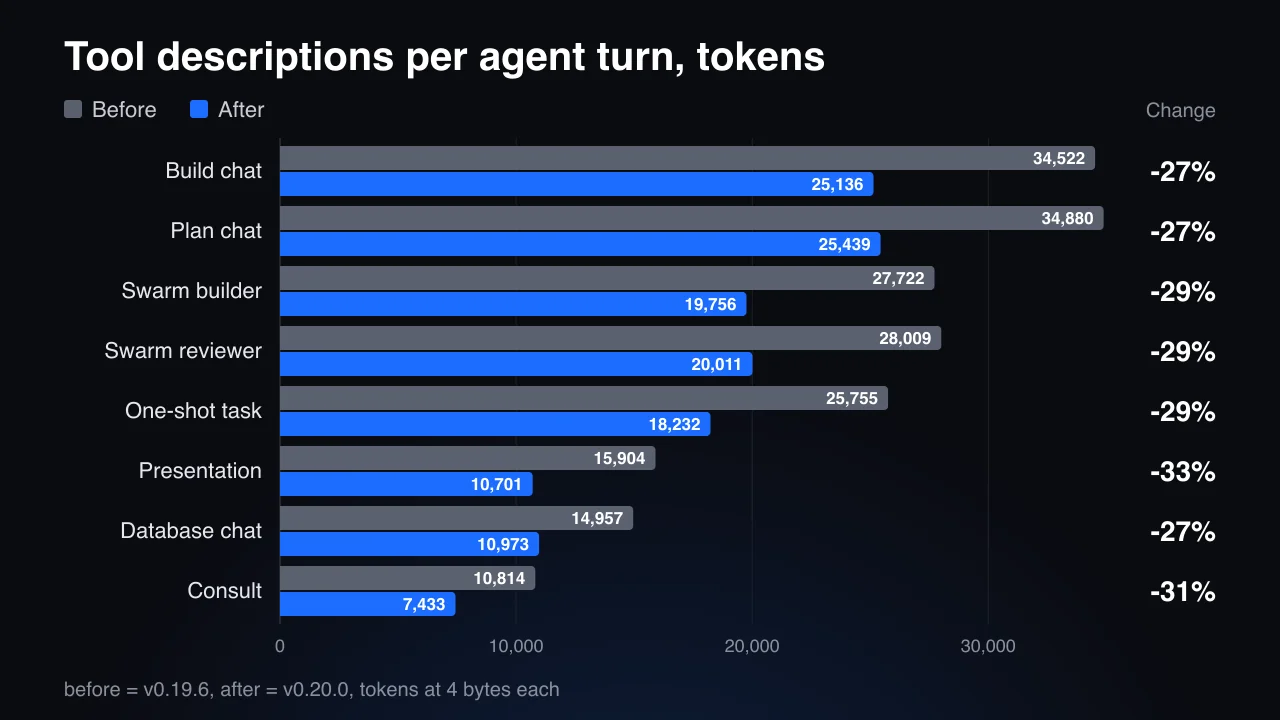
We measured the tool descriptions each turn carries in v0.19.6 and in v0.20.0, with tokens estimated at four bytes per token. Each agent kept every tool it had, and some gained one, the new docs tool.
| Chat profile | Tokens before | Tokens after | Change |
|---|---|---|---|
| Build chat | 34,522 | 25,136 | -27% |
| Plan chat | 34,880 | 25,439 | -27% |
| Swarm builder | 27,722 | 19,756 | -29% |
| Swarm reviewer | 28,009 | 20,011 | -29% |
| One-shot task | 25,755 | 18,232 | -29% |
| Presentation | 15,904 | 10,701 | -33% |
| Database chat | 14,957 | 10,973 | -27% |
| Consult | 10,814 | 7,433 | -31% |
Here is how. Tool descriptions are written more compactly. Each rule is said once. The long guidance and examples moved into a docs tool that agents read before their first presentation or canvas write. Claude and Grok load a tool's full description only when they need it, and the other CLIs load the shorter list.
We set one rule for this work: savings come from waste only, never from the reasoning or the guards Sokudo gives its agents. To check it, a new tool-use evaluation of 66 cases was replayed on Claude (Sonnet) and Codex. Claude now scores 98 percent, up from 82 before this work, and Codex scores 95 percent, up from 85. The scores went up while the tokens went down. One limit remains: Kiro runs on its V2 engine, so its tool list is always sent in full.
Bug fixes and stability
- A chat that tells the same story. Review each on the restart line finds the worker's card wherever it is, and the restart line never contradicts the chat. Scrolling up for older messages no longer mixes chats, a reply the server could not save no longer holds the turn for eight seconds, and a full disk is reported once, with a toast.
- A tidier Database Manager. The pager is centered, and the grid, record, tree and text views, column copy and the selection summary work on the loaded page only.
- Language servers that explain themselves. A check that times out now says why, and a path longer than Windows allows is reported once, with its length and the limit.
- A managed engine that repairs itself. When the launch check finds an outdated bundle, the engine repairs itself. Two installs at once no longer show a false failure, Reinstall and Recover no longer race, and a wsl.exe hiccup on Windows is reported as exactly that. On Linux without a Secret Service, Sokudo falls back to the kernel keyring, and on macOS the local domains warning shows once per install.
- Windows. Waking from sleep no longer reports the window as frozen, a missing WebView2 is named with the download offered, a terminal crash on long prompts is fixed, and a linked worktree keeps its Claude servers, trust and approvals.
- A clean browser for every run. The browser profile your agents use is cleared after each run.
- Plus fixes for the error reports we reviewed on November 4 and 5.
What is next
OpenCode v1 is deprecated and will be removed in the next release. OpenCode v2 stays supported, so if you still use v1, move to v2 before then.
Sokudo is close to its official launch. At launch, Sokudo becomes a fully paid product.
Every app below v0.20.2 takes this release as a required update. As always, Sokudo updates itself. The public beta is open at sokudo.dev, so try v0.20.2 and tell us what you want to see next.
- Changelog
- Product